
Meet Kissmet, the emerging London-based band delivering radiant indie-pop music
Meeting in 2024 following an intricate chain of serendipities, Alex, Maggie and Ted formed Kissmet, the rising London-based trio releasing infectious, radiant indie-pop. Their songwriting blends modern pop melodies with harmonies and nostalgic instrumentation to create a unique retro-modern sound.
On new single Memory Star, the band explore the complex relationship between limerence and alienation, blurring the lines between artist and muse, observer and observed, and set it to the backdrop of an old Hollywood-inspired, dreamlike cinematic world.
Ahead of the single release, Kissmet reflect on their DIY approach to music-making, the collaborative dynamic at the heart of the band, the cinematic influences behind Memory Star, and how they’re carving out a distinctive place in the current UK indie landscape.
Memory Star is your fourth single – how would you say it represents your evolution since your earlier releases?
Our first three releases trace the steps to us finding our feet as a band, learning to understand each other’s tastes, style and ways of working. A real turning point came with ‘Memory Star’, where we consciously sat down to discuss our own musical tastes, before a writing session in the afternoon. With a big blank page in front of us, we wrote down every artist, band, live performance or album that had left an impression on any of us. Before we knew it, hours had passed, and the page was full. ‘Memory Star’ was written that afternoon, and felt like the first true realisation of an equal collaboration, and a new understanding of where we each came from musically.

The track has been entirely written and produced in-house. How do you think having this level of creative control has shaped your musical identity compared to working with collaborators?
It’s a really incredible thing when you find two other people who understand your vision as clearly as you do. To have two other creative partners who you trust implicitly, and who share your goals. It means we all feel safe to make mistakes, to grow and experiment, in a supportive environment. Although we aren’t collaborating with external artists or writers right now, we do still collaborate with each other every day: something which we all agree is a highlight of making music.
You cite The 1975 and Jean-Jacques Goldman as influences on this track. What specific elements of their work resonate with you, and how do you reinterpret them into an indie-pop context?
Both of these artists use very similar instruments in their production, which we also incorporate into our music; acoustic guitars alongside electric guitars, a very light drum beat driving the track, overlaid with twinkly, guitar-based flourishes to add texture. French music is particularly important to us, as Alex grew up listening to Goldman, and lyrically, we see the French chanteuse of Goldman’s predecessors as the base for rich and in-depth lyricism and storytelling. Interpreting this into a more modern pop scenario means distilling melodies into more memorable phrases, and writing our lyrics in English for our UK audience!
There’s old-Hollywood inspired lyrical dialogue on this track. Were there any specific films or actors that influenced you and your creative direction when making this track?
The opening of the song references a ‘little Marilyn’, which we love for its multifacetedness: it’s at once a loving term of endearment and a darker, more possessive name. The figure of Marilyn Monroe, idolised and misunderstood, sums up the metaphor of ‘Memory Star’ perfectly. We even thought about ending the song with a quote from her, and that beautiful lilting voice: ‘I’ve had you fame, if it goes by I told you it was fickle’.
Memory Star is a feel-good indie pop track blended with complex emotional themes. How did you approach balancing that contrast within the writing and recording process?
We are big fans of songs where a slightly darker theme is contrasted with lighter instrumentation. As a band, we always want our songs to strike a balance, and we want audiences to feel like they can unpack and discover layers with each listen.
You’re celebrating the release of the single with an intimate launch show at The Good Oak. How does performing in a smaller venue like this shape the way you approach a live show?
With our first year of releasing music, we really wanted to build a community of fans by playing shows in smaller venues with free tickets. We try to reimagine the songs for smaller audiences in a way that you couldn’t do in a larger venue; creating an intimate atmosphere where no show is the same.
BBC Introducing has been an early supporter of Kissmet. How important has that support been in helping you reach new audiences as a DIY band, particularly when most new music discovery is now driven by social media?
We’re indebted to Dean Jackson and the team at BBC East Midlands for championing and supporting us. They had us up for our first radio interview in May, have played us multiple times across stations, and are having us for a show in September. We’ve had people reach out to us to say they discovered us through radio, which was so special. We always embrace any new ways in which people can find us.
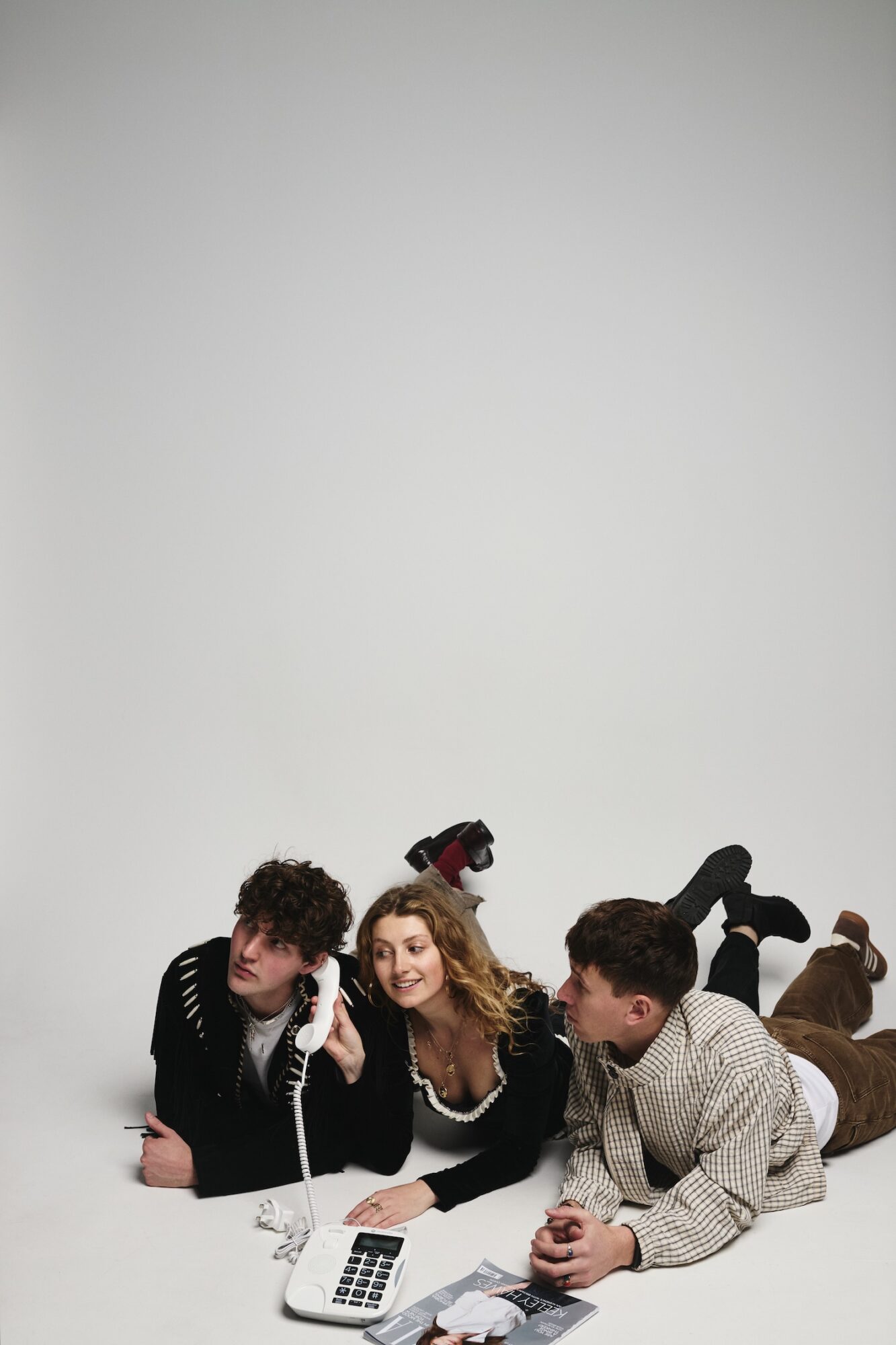
Your collaborative structure challenges the idea of a singular frontperson. How do you decide who takes the lead on different sections of your songs, and what does your creative process look like?
Vocally, who takes the lead very much depends on the narrative of each particular song. Through everything we do, we try to equally share the load and responsibility, and this goes for performances too. What makes Kissmet so special is that it is a product of three people’s equal creative input.
You formed through what you’ve described as “an intricate chain of serendipities”. What’s the story behind how the three of you first connected?
In the winter of 2024, Ted and Maggie, who had met at a party a few years previously, decided to set up a writing camp and take it to France. The first thing they needed was someone who knew the area, and most importantly, made music. A week later, at a studio for the recording of a charity Christmas song, Ted met Alex. Not only was he from France, but he was also a brilliant producer. When the two got to talking, they realised that a tarot reader from North London had already connected the dots. Energised by the magic of the meeting, Ted pulled Maggie and Alex together for their first writing session, and we wrote what would become our first single, ‘Darling Don’t You Know Me’.
For anyone discovering Kissmet for the first time through this release, what do you hope they take away from your music and how would you define your sound?
If you’re reading this, we feel so lucky that our paths have crossed. For anyone listening to us for the first time, we’d want them to feel a sense of escapism through our music, whether it uplifts, moves or simply makes you dance. Kissmet is about community, and everyone is welcome here; especially if you see the world a little differently.
Check out Kissmet’s latest track ‘Memory Star’ here or below!